

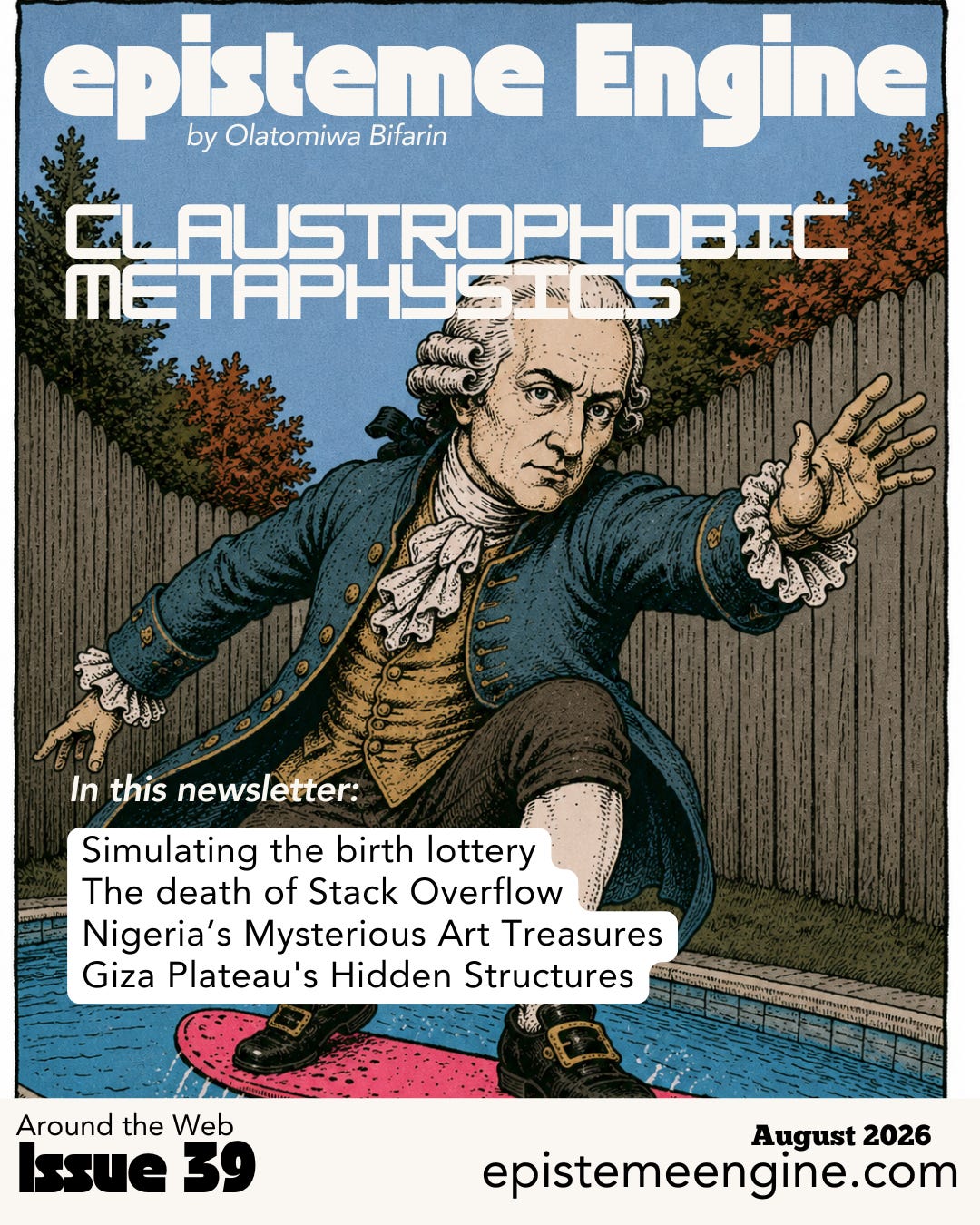
Looking back at my log, it just dawned on me that I have not written one of these since last December, this is largely because of my new adventures: running, learning to build AI products, and starting an applied AI company (as a solo founder) has been thoroughly time consuming. I would probably take the time to write more about my experiences in the future.
In the meantime, Around the Web Issue 39.
For books, go the end of post.
[Talking Points]
Simulating the birth lottery.
NIH Chief X Ross Douthat.
The three African Guineas.
What happened to reading?
The death of the Stack Overflow forum.
Record number of Americans are living alone.
Milestone 70 Percent 5-Year Survival Rate for Cancer.
Most common religious affiliation by country.
Walmart hits $1 trillion market value.
Best Goals of AFCON 2025.
Hausa Insurgency in North Nigeria.
Violent Crime Rates in the United States.
Indian Students sing “Aimasiko“
Mutsuhiro Watanabe Interview
Yoruba tribe in Ketou, Benin Republic.
Youngest Catholic Bishop in America.
Nassim Taleb on hard copy books.
[Longer Reads/Watch]
😜Fun Criterion
Here, David Deutsch explains the “fun criterion”. My initial thoughts about what he seems to be saying at the beginning was that “fun” is the feeling that arises when you’re making progress on a problem: when things are moving forward, you naturally want to keep going, and when you’re stuck or frustrated, the absence of fun signals that progress has stalled. In this sense, fun functions like a motivational feedback loop and can be used as a heuristic for deciding whether to persist or change direction.
But his claim is deeper than this “progress-as-motivation”. My reading is Fun is not merely a reaction to visible success, nor a reward for effort; it is an epistemic signal that internal error correction is occurring. Human thinking consists of interacting layers of explicit, inexplicit, and unconscious ideas that are constantly in tension. Fun arises when those competing ideas are being productively resolved, when confusion is decreasing, explanations are improving, or even when a better problem is discovered. Conversely, frustration is not just “no progress” but evidence of unresolved internal conflict: rival explanations are clashing without resolution. I think I like this idea very much, the fun criterion is not “continue if it feels good,” or even “continue it, even if you don’t feel good” (no pain no gain); but “continue if you are reducing error and resolving contradictions,” even when the work is hard, slow, or externally unsuccessful. This explanation maps quiet well to my experiences in my startup, even though I am don’t even have a product yet.
🎲Casino is Not the Only Option
The Casino Is Not the Only Exit

The essay quietly advances a binary: 1) White-collar work is cooked
2) Therefore, gamble
This framing collapses too many alternatives and overfits to a narrow slice of the economy.
Late last year, an essay landed in my siblings group chat. I read it and started flooding the chat with messages, and then realized quickly that this probably wants to be an essay. So I wrote one.
The original essay, titled “The Prison of Financial Mediocrity” by Systematic Long Short, argues that younger generations, locked out of traditional wealth paths and facing accelerating disruption from AI, are rationally turning to high-variance “casino” systems (crypto, prediction markets, sports betting) as the only remaining sources of perceived agency.
As white-collar career ladders erode and social media amplifies status anxiety, gambling becomes less about ignorance and more about desperation under constraint. The author frames this as a structural, not moral, phenomenon and concludes that the winning move is to “long the platforms”, the argument that because the house always wins, the only rational move is to invest in, or align with, the “casinos” extracting fees from the desperation. I argued against the proposition.
💼 AI: Agency Strategy For next 5 years

David Shapiro argues that the AI transition will dismantle wage labor faster than most people expect, and that high-agency individuals should respond across four fronts: where they live, how they invest, what kind of work they pursue, and, most importantly, what mission gives their life meaning. Remote work and automation decouple income from geography, making lower-cost, values-aligned communities more attractive. Capital ownership and disciplined saving matter more than ever as jobs erode. Traditional knowledge and single-task labor will shrink, while attention, experience, authenticity, and meaning-driven roles persist, often augmented by AI rather than replaced by it. Shapiro contends that a post-labor future demands shedding hustle-based identities and orienting life around purpose, creativity, and human flourishing, because no institution will “empower” you unless you first empower yourself.
Our Mathematical Reality
In this episode of Uncommon Knowledge, Peter Robinson moderates an enjoyable discussion featuring mathematician David Berlinsky, Princeton professor Sergiu Klainerman, and philosopher of science Stephen Meyer on the mysterious “unreasonable effectiveness” of mathematics in describing the physical world. They explored how mathematical truths function as an immaterial reality that exists independently of human invention, directly challenging the foundations of strict materialism. Klainerman emphasizes the “mathematical test of reality” through his work on black hole stability, while Meyer argues that the conceptual nature of these objective truths suggests they originate in a transcendent mind.
I have a related video essay on this subject matter:
Giza Plateau’s Hidden Structures
Filippo Biondi discusses his groundbreaking satellite-based radar tomography that he says revealed immense, undiscovered structures deep beneath the Giza Plateau. Utilizing technology originally developed for military and industrial applications, his team identified massive vertical columns, spiral coils, and horizontal corridors extending up to 1.2 kilometers below the surface. These findings challenge the traditional archaeological narrative that the pyramids served merely as tombs, suggesting instead that the structures functioned as sophisticated mechanical devices designed for harmonic resonance and energy generation. Biondi highlights evidence of ancient flooding within these shafts and is currently proposing a collaborative, robotic exploration of the site to physically verify what he describes as a “paradigm-shattering” discovery that could rewrite the history of human civilization.
I listened to the episode on an 18km run earlier in the year, and I found it utterly fascinating. But the thing is, what I believe to be the underlying paper for this discovery was recently redacted. That being stated; I did not get the time to dig into the weeds: what still plausibly stands, what’s definitively wrong, what’s still up for debate, that kind of thing.
See the redacted paper.
Nigeria’s Mysterious Art Treasures

This is a fine documentary about Ile-Ife art; one of the excavation sites featured is very close to where I lived as child and teenager. One of the archaeologists in the film also wrote this book (which I’ve been planning to read); it looks like it will offer a more “solid” perspective compared to the takes on the subject matter by Samuel Johnson and Professor Akintoye.
Claustrophobic Metaphysics
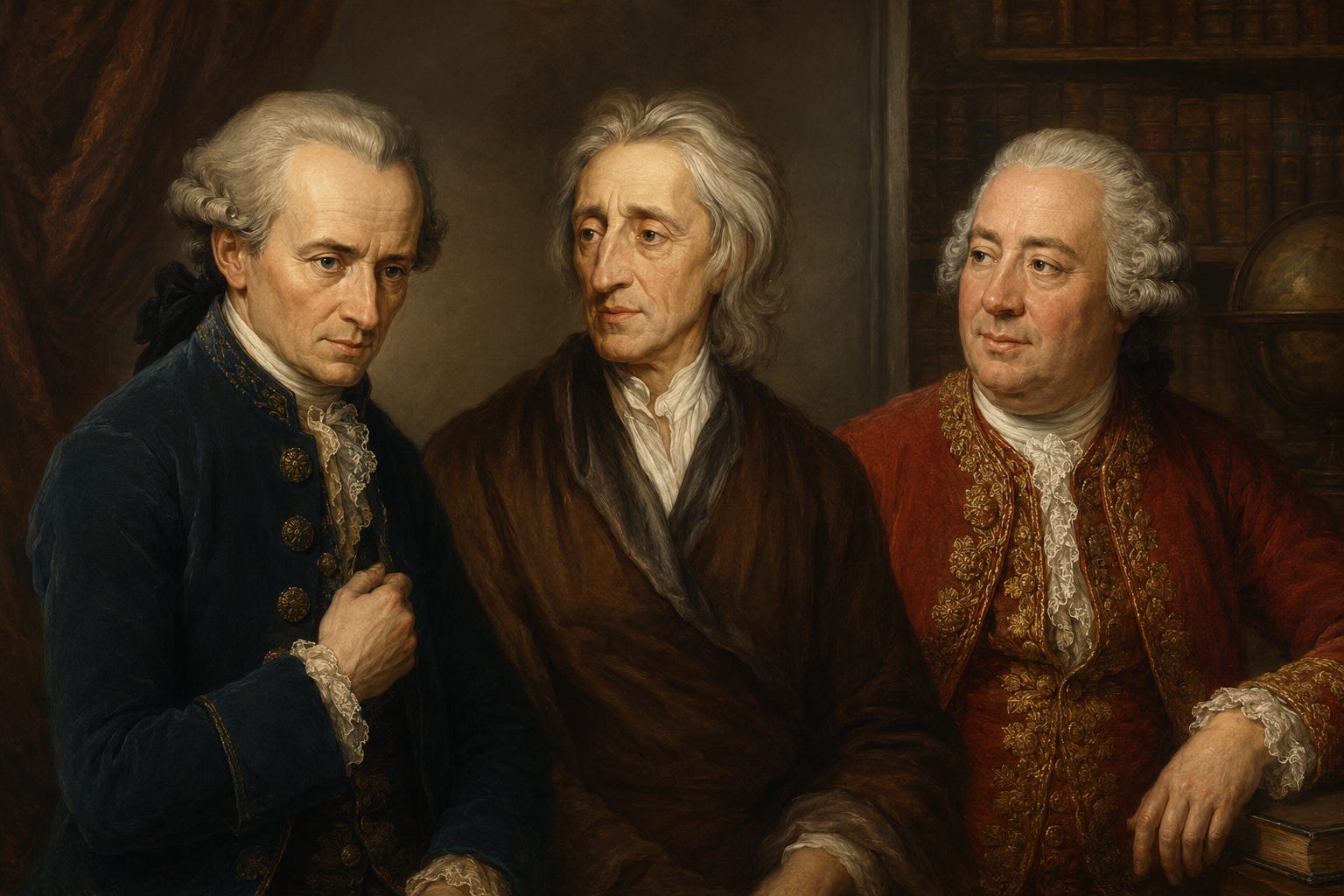
This essay from Ed Feser provides a clear-eyed intellectual history of the shift from classical realism to modern subjectivity in Western philosophy. He critiques how thinkers like Descartes, Locke, and Hume moved away from prioritizing the objective natural world to focusing exclusively on the internal human mind, a transition that ultimately led to skepticism and idealism. Immanuel Kant was presented as a pivotal figure who attempted to synthesize these views by proposing that the mind imposes structural order on sensory data, yet simultaneously restricted human knowledge to mere appearances rather than reality itself. This “revolution in thinking” move is examined through its expansion into moral philosophy, where Kant argued that reason legislates its own ethical laws through the Categorical Imperative. The final argument goes something like this: Kant’s “internal turn” inadvertently fostered a culture of moral relativism and a sense of human arrogance by detaching truth from an independent, external foundation.
How Earth’s Night Lights Became Our Most Honest Economist

Fascinating look at the unexpected intersections of technology and economics, Frank Jacobs over at Big Think explores how a Cold War-era satellite program inadvertently created our most reliable global economic indicator. Originally launched by the U.S. Air Force to track cloud cover for military operations, the Defense Meteorological Satellite Program’s sensors also captured the planet’s artificial light at night, illuminating everything from city sprawl to gas flares. Today, this nighttime luminosity serves as a fiercely independent fact-checker against official government narratives, capable of accurately mapping GDP, poverty levels, and even illegal fishing. Interesting data science story.
[Books/Papers 📚]
Book(s) I recently completed: [-]
Self Help from the Middle Ages [Link]
Self Help from the Middle Ages

Book: Self-Help From the Middle Ages: A Journey Into the Medieval Mind by Peter Jones.
What I am currently reading: