

Book: Self-Help From the Middle Ages: A Journey Into the Medieval Mind by Peter Jones.
Medieval writers and thinkers, especially those thinking through the Seven Deadly Sins, had a serious understanding of the human psyche. They may not have had our vocabulary of dopamine, trauma, burnout, attention economy, clinical depression and the likes, but they understood something fundamental about the human person. They knew that we are unstable creatures, easily captured by desire, comparison, resentment, appetite, and despair.
Jones did a great job fleshing this out in his book “Self Help from the Middle Ages” which he organizes around the Seven Deadly Sins: Pride, Envy, Anger, Sloth, Avarice, Gluttony, and Lust. But he does not treat them as religious vocabulary. Instead, he treats them as some sort of diagnostic categories.
Pride is not simply pride, it is the refusal to see oneself truthfully. Envy is not merely wanting what another person has. It is the spiritual sickness of being pained by another person’s good. Anger is not only loss of control. It is also seduction, because rage gives us the intoxicating feeling that we are obviously, and unquestionably right. Sloth, especially in its older form as acedia, is not laziness. It is the utter collapse of care.
A hurry-look-around, would convince even the most dim witted persons amongst us that we have not escaped the Seven Deadly Sins. If anything, we have industrialized them - we blew it up. This is the part worth sitting with. “Our problems” are not new; they are old. In some respects, what is new is how we have used our technologies to intensify them.
Envy used to require proximity. You had to see your neighbor’s field, your colleague’s promotion, your friend’s marriage, your rival’s applause. Now envy arrives infinitely refreshed, algorithmically arranged (with precision, I must add); and backlit in your hand.
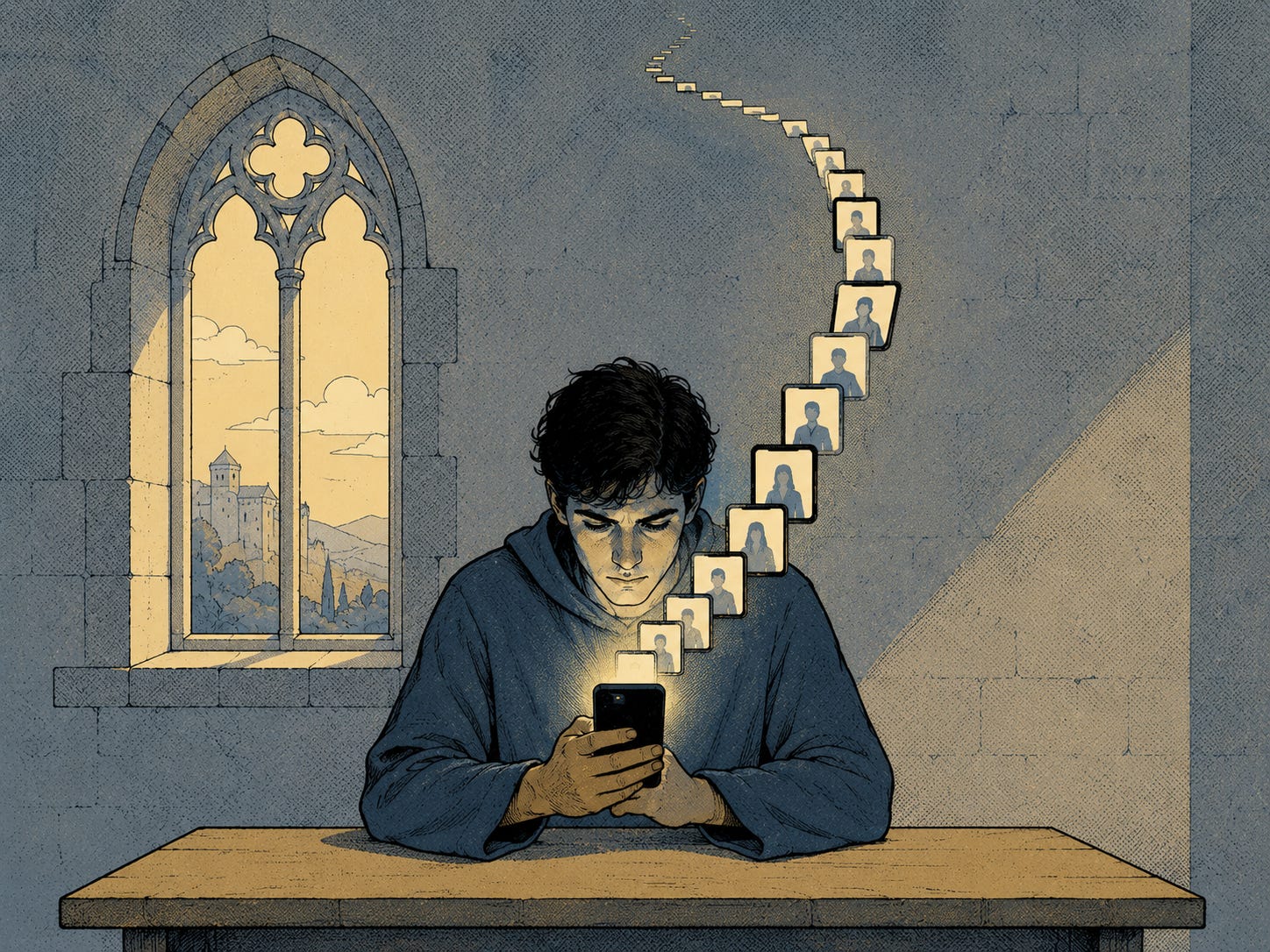
Pride used to need an audience. Now the audience is always potentially there, just boast away. Anger used to burn in the room, the court, the tavern. Now anger can become a personality, a business model, a media strategy. Ever heard of rage bait? sounds familiar? And please, don’t get me started with Gluttony.
You put all these together and all the talks about the “modern” mental crisis suddenly makes sense (What would be shocking is such crisis not happening)
And then, on the other end, we use technology to solve the very problems technology has ramped up. We create apps to manage the attention destroyed by apps (I use the Freedom app, for example). We create wellness industries to soothe the exhaustion produced by overwork. We create subscription products for loneliness, meditation platforms for people whose lives have been engineered into fragmentation. Vast section of our economies now grow out of misery, with some, offering half-solutions to the conditions they quietly depend on.
Inspite of our insane material success, the argument wages on, why are we not happy? - that is another separate, but related, kettle of fish.
Or are we doomed to fail? The book does not flatter us with the idea that we are uniquely broken. It places us inside a longer human story. The names have changed. The technologies have changed. The economies have changed. But the soul, that stubborn old thing, is still fighting many of the same battles.
And perhaps that is comforting. Not because our problems are small, but because they are shared. Others have been here before. Others have mapped these dark roads. Jones’s book asks us to pick up those maps again, not as antiquarian curiosities, but as instruments, maps for living.