

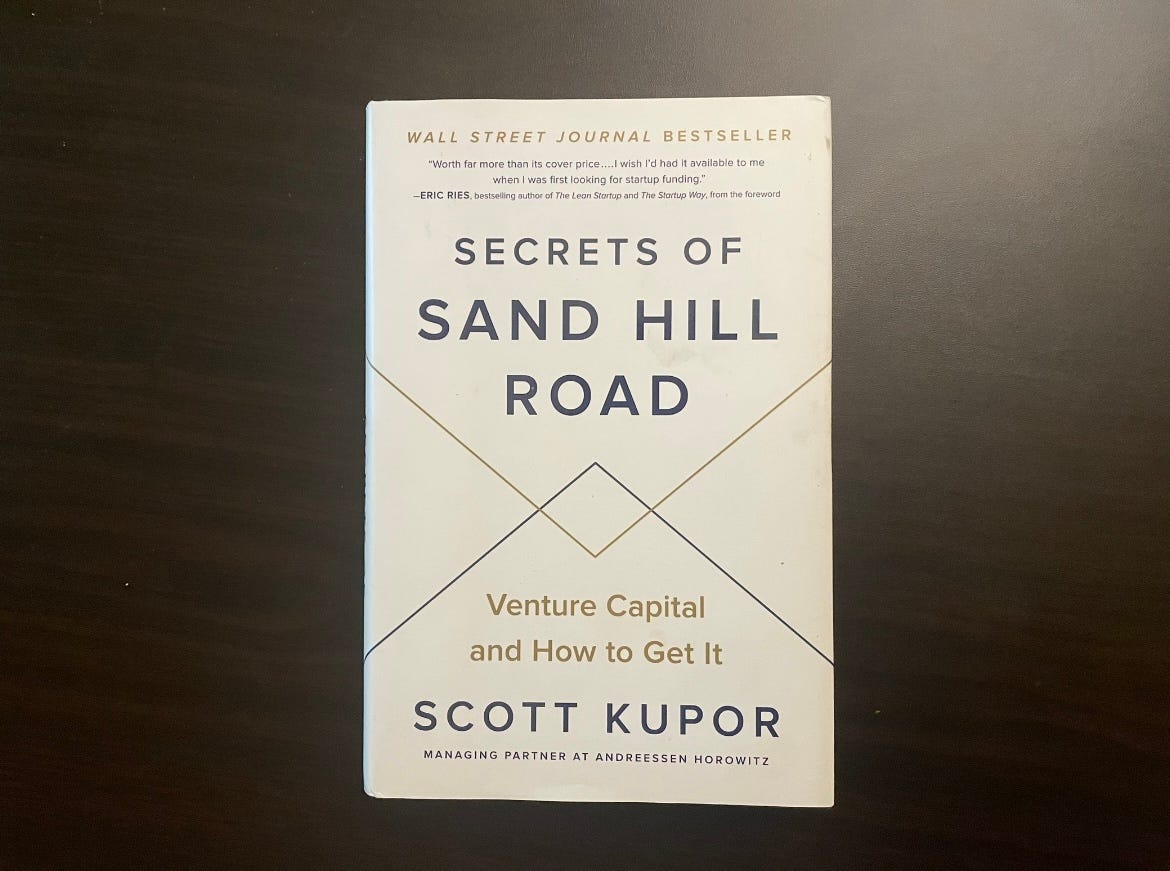
Book Title: Secrets of Sand Hill Road.
I wanted to learn more about venture capital, so I picked up the book Secrets of Sand Hill Road written by Scott Kupor of Andreessen Horowitz. The following are some of my notes grouped (loosely) by themes.
I. The Tyranny of the Power Law
One cannot understand the behavior of a venture capitalist without first grasping the mathematical reality they live in: the Power Law. In most walks of life, outcomes follow a bell curve. In venture capital, returns are heavily skewed. As Kupor illustrates using a baseball analogy, VCs aren’t looking for a high batting average (getting a “hit” every time); they are looking for “at bats per home run”.
The math is stark: VCs expect >50%? of their investments to return nothing. To offset those losses and generate the massive returns their own investors (Limited Partners) demand, they need the winners to return 10 to 100 times the invested capital. This is why a VC might pass on a perfectly good business that has a high likelihood of becoming, say a $50 million company; it simply doesn’t move the needle for a fund that needs to return hundreds of millions.
Understanding this helps to realize that when a VC pushes for hyper-growth, they are simply trying to survive the math of their own industry.
II. The Structural Foundation: C Corps and Stock Classes
Everyone knows corporate structure isn’t just paperwork; it’s strategy. Kupor emphasizes that while the LLC or partnership model might seem tax-efficient for a small business, the C Corporation is the non-negotiable standard for venture-backed startups. This is largely because the Limited Partners (LPs), the endowments and foundations funding the VCs, are tax-exempt entities.
And if a tax-exempt entity receives income from an active trade or business (like a startup) through a “pass-through” entity like an LLC or partnership, that income is classified as Unrelated Business Income (UBI) and is subject to tax. This creates a “tax penalty” for the LP, effectively eroding their tax-free status for that investment. By investing in a C Corporation, the tax liability remains contained within the corporation itself, blocking it from passing through to the LPs and preserving their tax-exempt standing.
Furthermore, the C Corp structure facilitates the necessary hierarchy of ownership: Preferred Stock vs. Common Stock. VCs require Preferred Stock to secure specific economic and governance rights (like liquidation preferences), while founders and employees hold Common Stock.
Take liquidation preferences, it ensures that in a “downside” scenario (e.g., the company sells for less than hoped), the VCs get their money back before the founders see a dime. Conversely, if the company is a massive success, VCs can convert their Preferred shares to Common and participate in the upside. This structure protects the investor’s capital in failure while allowing them to share in the “home run,” aligning their risk profile with the high-stakes nature of the bet.
III. Misaligned Incentives, Fund Cycle, & “Ruling from the Grave”
One critical factor Kupor highlights is the Fund Lifecycle. Most VC funds have a 10-year lifespan. If a VC invests in your company during year 8 of their fund, they may be under immense pressure to force a liquidity event (like a sale) sooner than you would like, simply to return cash to their LPs before the fund expires .
Startups must also watch out for the “Zombie Fund” scenario. If a VC firm has performed poorly and is unlikely to raise a subsequent fund, they may lose the ability to “reserve” capital for future rounds. This can leave startup stranded without the follow-on capital they expected. Knowing where VC stands in their own fundraising cycle is just as important as them knowing startup’s financials.
This ‘alignment’ discussion also extends to governance. Kupor introduces the somewhat macabre but critical concept of “ruling from the grave”. This occurs when a founder retains a board seat purely by virtue of being a founder, even after they have left the company. To prevent a former operator from holding the company hostage, board seats should be tied to current service (say, the CEO role) rather than the individual person.
IV. The Art of the Pitch and Early-Stage Decision Making
When early-stage VCs decide where to invest, they are often operating with very little hard data. Consequently, their decision-making heuristic relies heavily on three pillars: People, Product, and Market. Of these, market size is paramount because of the aforementioned power law, a great team in a small market will still fail to return a venture fund.
A successful Pitch must therefore articulate a narrative around these elements:
Market Size: convince the VC that the opportunity can generate billions in value.
Team: Specifically, “founder-market fit”, why this team is uniquely qualified to solve this problem.
Product: Is it a vitamin (nice to have) or an aspirin (need to have)?
Go-to-Market: A plausible strategy for acquiring customers.
V. Valuation: The “Dark Art” and Convertible Debt
Valuation is often more art than science. How does a VC conduct valuation of startups? Kupor outlines a few methods, ranging from Comparable Company Analysis (looking at public comps) to the Option Pricing Model (OPM). However, for early-stage startups, it often boils down to a “what do I need to believe” analysis, calculating what the company must look like in ten years to generate a 10x return.
On a related subject: In earlier rounds, founders often use Convertible Debt. This allows them to raise capital quickly without setting an explicit valuation immediately, “kicking the can” down the road to a priced equity round. While efficient, founders must be wary of valuation caps. A cap sets the maximum valuation at which the debt will convert into equity. If your company grows wildly and raises a Series A at a valuation far above the cap, the debt holders get to convert at the lower cap price. Effectively, you have priced the round, you just set a ceiling on it, giving early investors a guaranteed lower price relative to your future success.
VI. Protecting the Cap Table: Vesting and Transfers
The “prenup” elements of a startup are vital for long-term health. Founder Stock Vesting is essential not because partners don’t trust each other, but to align incentives over the long haul which is typically a four-year period with a one-year cliff.
Equally important are Transfer Restrictions and Rights of First Refusal (ROFR).
ROFR: If you want to sell your shares to a third party, you must first offer them to the company (and often the investors) at the same price. This creates a “chilling effect” on buyers, who don’t want to negotiate a deal only to have it snatched away by the company.
Transfer Restrictions: These are even stricter. They dictate that you cannot sell your shares at all without the company’s consent. This ensures that the founders remain “locked in” and aligned with the long-term vision, preventing them from cashing out early while the VCs are still holding the bag.
Finally, regarding exits, Kupor champions Double Trigger acceleration as the industry standard for fairness. Single Trigger means your unvested stock immediately vests solely upon the sale of the company (Change of Control). Acquirers hate this because they are often buying the company to get the talent. If you fully vest the day they buy you, say, you have no financial incentive to stay. Double Trigger, on the other hand, solves this tension. It requires two events: 1) The sale of the company, AND 2) Your termination without cause (or leaving for “good reason”) . This protects the acquirer by keeping you incentivized to stay, but protects you from being fired right after the acquisition and losing your unearned equity.
VI.
There is so much more discussed in the book than highlighted here, including a detailed examination of Term Sheets. For those interested in venture capital, it seems this is one of the oft-recommended books, and I enjoyed reading it.