

Thomas Manabu’s The Machine Consumes Itself: Artificial Intelligence and the End of Publish-or-Perish is an incisive take on the impact of generative AI on the future of academia. Its starting point is academia’s doxa: the deeply accepted assumption that publication counts and citations measure a scholar’s worth.
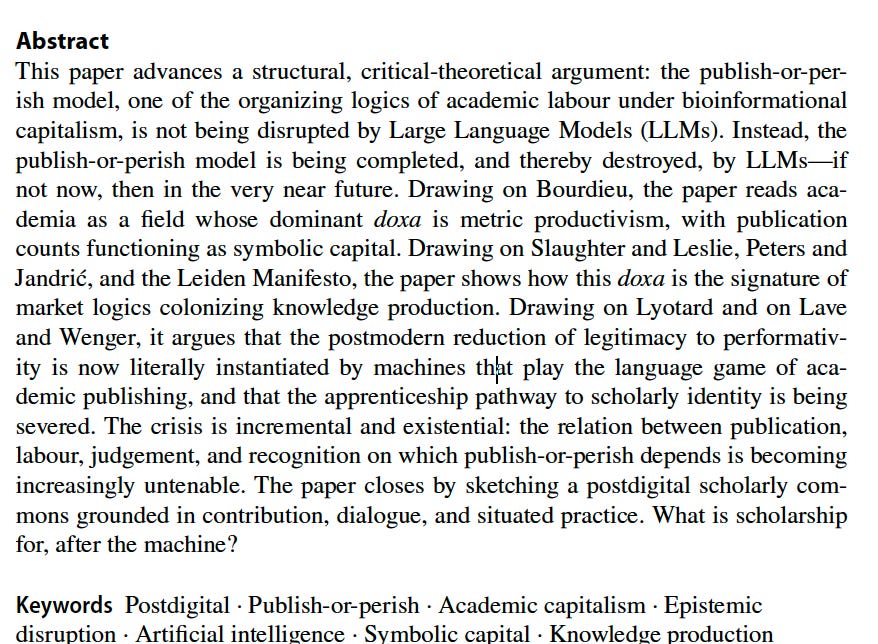
The argument is straightforward: GenAI makes plausible academic papers cheap and scalable, so that publication counts can grow without a corresponding increase in discovery, understanding, or scholarly judgement.
(As a side note, on discovery, I should note that even before GenAI, especially in the sciences, there were studies suggesting that increased publication output was not translating into a commensurate increase in disruptive science (Chu and Evans, 2021; Park et al., 2023)).
And here is the central twist of the paper: AI undermines publish-or-perish by fulfilling its demand for ever more output so thoroughly that the output loses credibility as a measure of scholarship.
Manabu puts the institutional argument quite sharply:
University administrators can require publication counts from candidates only as long as the counts mean something. Funding agencies can rank applicants by citation metrics only as long as the metrics track something real. Governments can flatter elite universities by citation league tables only as long as the league tables are not visibly constructed from machine output evaluated by machine reviewers. The collapse runs faster than the institutions’ capacity to absorb it. The reconstruction, however imperfect, becomes less an option than a forced response to a vacuum.
The paper is thoroughly argued, though I wonder whether undermining the credibility of publication counts necessarily means the collapse of publish-or-perish. Institutions could continue rewarding output even after it has become less meaningful as a measure of scholarship. The system could become more dysfunctional and still persist. There are plenty of systems like that if you just take your time to look around. Still, it has to be said that, at some point, the gap between what the system rewards and what it claims to measure could become so ridiculous that the whole thing becomes untenable.
Manabu also makes a point about friction (in the context of what our attention should be focused on going forward):
Seminars, workshops, viva voces, conference exchanges, sustained mentorship, pedagogical relationships, fieldwork, laboratory life, are all practices in which the scholar is present in a way that an artefact cannot be present. They do not scale. That is their virtue. They reintroduce friction into a system that has been optimized toward frictionlessness, and friction is, in the present circumstances, the condition of legitimation.
This also leads me to expect different outcomes for different subsets of academia. For example, there is still a great deal of friction in lab experimentation for wet lab scientists. That friction constrains the production of reliable evidence, even if plausible papers can still be produced without it. This perhaps provides a bit more surface on which to anchor a new paradigm of “scholarly worth,” with greater emphasis on verifiable experimental contributions (to the extent that robotics doesn’t eat into this edge).
In the end, and this is where I am particularly interested, we need new and updated infrastructure that does for verifiable scholarly contributions what journals and citation indexes have done for publications: make them visible, open to scrutiny, and properly recognized. If plausible papers become cheap to produce, there is a need for stronger grounds for deciding what they tell us about the scholar behind them. I expect this to bring substantial change in how we assess scholarly worth. What remains open is what form that change will take, how long it will take, and whether the measures that emerge will actually be better.